
Editorial Note: This article contains inaccuracies regarding the composition of the Fulton County Commission, incorrectly listing Cobb County Chairwoman Lisa Cupid as a voting member. It is currently under review by our editorial team.
The Fulton County Commission voted 4-3 Wednesday night to rezone roughly 280 acres in south Fulton for two new hyperscale data centers, clearing the way for what would be among the largest such facilities in the country.
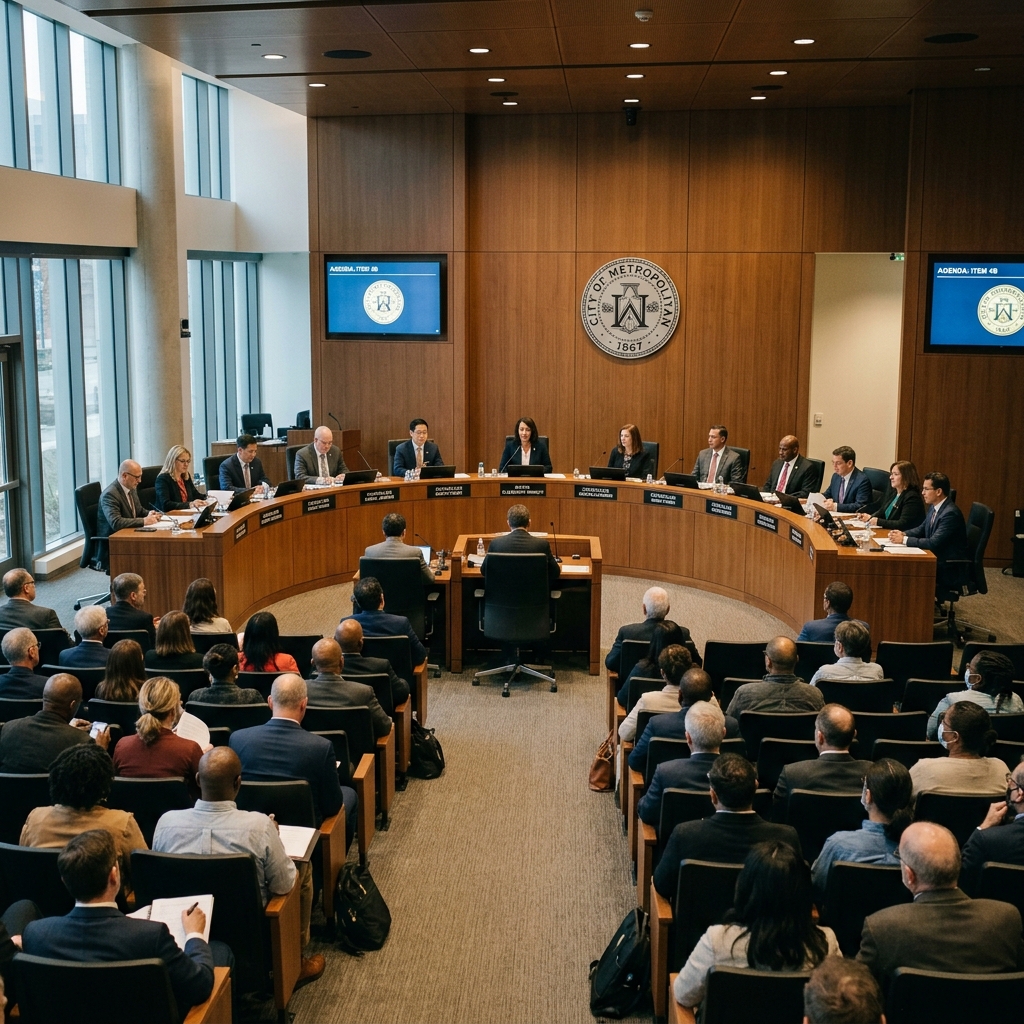
The vote, taken at a contentious 5-hour meeting, was the most-watched local political action in metro Atlanta this year. More than 200 people attended in person; the meeting room spilled over into an overflow space.
The decision is already facing a legal challenge from a coalition of south-Fulton homeowners, who said Thursday morning they will file suit within 10 days.
What’s in the rezoning
The rezoning covers two adjacent parcels — one 140 acres near the Union City city limits, the other 140 acres near Fairburn. The parcels are currently zoned for light industrial and agricultural-residential use. The new zoning is M-2 (heavy industrial) with a data-center overlay.
The rezoning clears the way for two facilities:
- A 640,000-square-foot facility on the Union City parcel
- A 1.1 million-square-foot facility on the Fairburn parcel
Combined, the two facilities would draw an estimated 85 million gallons of water per day at full build-out — roughly the daily consumption of the entire city of South Fulton (population ~110,000).
The vote
The four commissioners who voted yes:
- Robb Pitts (District 1, Commission Chair)
- Bob Ellis (District 2)
- Lisa Cupid (District 4)
- Natalie Hall (District 6)
The three who voted no:
- Joe Carn (District 3)
- Marvin Arrington Jr. (District 5)
- Bridget Thorne (District 7)
The vote was widely seen as a referendum on the county’s economic-development strategy, with the pro-vote side arguing that the data centers will bring $140 million in annual tax revenue to the county and 2,400 construction jobs plus 450 permanent jobs; the no-vote side arguing that the water and power impacts are not adequately studied and that the affected neighborhoods (which are predominantly Black and lower-income) were not meaningfully consulted.
“This is the most important vote I’ve cast in 12 years on this commission. The tax revenue is real. The jobs are real. And so is the impact on the people who live there, and we have to take that seriously too.”
— Commissioner Hall, voting yes
“I cannot support putting the largest concentration of water use in the county in a community that has been asked to bear the burden of growth in this county for the last 50 years and has not been given a seat at the table.”
— Commissioner Thorne, voting no
The legal challenge
The coalition of homeowners, organized as the South Fulton Water Justice Coalition, said Thursday they will file a complaint in Fulton County Superior Court alleging that the rezoning violated the county’s comprehensive plan, that the required public-notice period was insufficient, and that the environmental review was inadequate.
The coalition has retained the law firm Bondurant Mixson & Elmore, which has a long track record of environmental and land-use cases in Georgia.
“The commission has the authority to zone, but they don’t have the authority to ignore their own rules when they do it. We believe the public-notice violations are clear, and the courts will see that.”
— Coalition attorney
The legal challenge is not expected to stop construction immediately — the developer has not yet filed a building permit — but it would put the matter on hold for at least 6 to 12 months while the case is heard.
What’s next
The developer, Atlas Data Partners of Atlanta, said in a statement that it “respects the commission’s vote and the public process” and is “committed to working with the community on the project going forward.” Atlas has not yet announced a construction timeline.
The county’s planning staff will now begin drafting a development agreement with Atlas that will govern the project’s water use, environmental mitigation, and community benefits. That agreement is expected to be finalized in late 2026.
Marcus James covers state and federal politics for WACN 21. Reach him at mjames@wacn21.com.